
Throughout the lifecycle of commercial buildings, energy consumption remains a persistent challenge.
HVAC systems account for approximately 40% to 60% of a building’s total energy use. As the “heart” that delivers cooling and heating while ensuring indoor air quality, the operating efficiency of Air Handling Units (AHUs) directly determines the overall energy efficiency.
Amid the push for carbon neutrality and rising operational costs, traditional fans often fall short of energy-saving demands. How can energy-saving potential be unlocked in existing buildings?

A recent AHU retrofit project at a shopping mall in Tianjin delivered measurable results:
Below is a detailed look at how EC fan technology contributed to this outcome.

Located in a bustling commercial district, this mall has been in operation for many years and sees heavy daily foot traffic.
Over time, the original AHU units began to show signs of wear and aging.

- The original belt-driven fans suffered from significant efficiency degradation due to long-term operation, making them a major source of high energy consumption.
- Key components such as belts and bearings had worn out, requiring frequent replacement and repair—increasing operating costs and maintenance workload.
- The outdated units lacked precise control, making accurate temperature regulation difficult and affecting the shopping experience.
- With limited intelligence, the 46 units provided no real-time feedback on operating status, requiring significant manual inspection efforts.
To support national energy-saving and emission-reduction goals while reducing operational costs, the mall’s management decided to carry out a comprehensive retrofit of these 46 AHUs.
This was more than a simple equipment replacement—it was a full upgrade of the mall’s energy management system.
Energy retrofits require data-driven decision-making.
At the start of the project, the technical team conducted a thorough assessment of the existing AHU system:

Original Fan Nameplate
● Operating Power Test – Actual power consumption of each AHU was measured.
● Static Pressure & Airflow Measurement – The performance curve of the original fans under actual duct conditions was evaluated, providing key data for EC fan selection.
● Noise Level Monitoring – Baseline noise levels were recorded to support acoustic improvements.
● Installation Dimension Measurement – Millimeter-level measurements ensured new equipment would fit seamlessly into the existing mechanical rooms.
● Meter-Based Monitoring – Real-time power quality data was collected via the building management system to facilitate post-retrofit energy comparisons.
The precise field data allowed the team to confidently commit to the expected energy savings and provided a solid foundation for selecting the appropriate EC fans.


Based on the detailed test data, the technical team developed a tailored retrofit solution for the 46 AHUs.
The core strategy was a full replacement with EC fans.
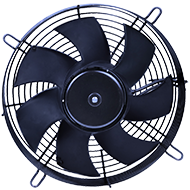
A total of 165 high-efficiency EC fans were installed, primarily using two models: A3E-3A630-Y8-58 and A3E-3A560-Y8-56.

Seemtek Achelous Series EC Fans
- EC fans feature built-in permanent magnet synchronous motors.
Compared to traditional AC induction motors, they eliminate rotor losses and maintain high efficiency even under partial load—a common operating condition for commercial HVAC systems. Data shows EC motors can achieve over 90% efficiency.
- Traditional AHUs often operate at fixed speeds, resulting in significant energy waste.
EC fans support 0–10V or RS485/MODBUS communication, enabling stepless speed adjustment based on occupancy and temperature fluctuations.
- With a compact design and direct drive operation, EC fans eliminate the need for belts.
For maintenance teams, this means no more belt replacements or belt dust cleanup, significantly reducing routine AHU maintenance.
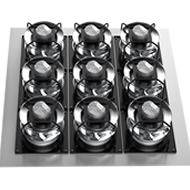
During the design phase, the team adhered to a principle of right-sizing. By leveraging the flexibility of EC fan array installation (fan wall), they ensured that maximum airflow requirements were met while optimizing energy consumption and cost.
Carrying out a large-scale AHU replacement in an operating mall presented logistical challenges.The compact size and light weight of the new EC fans proved valuable in the confined mechanical rooms. To avoid disrupting mall operations, the project team followed a standardized process prior to equipment delivery:
- Foundation inspection
- Fan placement
- Securing and connection
- Electrical wiring

Seemtek EC Fan Wall
Thanks to the modular design of the EC fans, installation complexity was greatly reduced. What previously took days for a single AHU retrofit was compressed to just 6 hours(removing old fans + installing new ones).
Hardware installation was only the first step. The true intelligence of the system lies in its controller.

Controller Tuning Interface
Once installed, the technical team integrated the EC fans into the building management system (BMS). Through fine-tuning with the controller, the AHUs evolved from delivering simple fixed airflow to achieving smart operation:
- Adjusting airflow to eliminate uneven cooling or heating
- Automatically regulating fan speed based on return air temperature, eliminating overcooling or overheating
Electricity meter readings before and after the retrofit confirm the results.
The table below compares data from AHU-1 over a 10-day period before and after the retrofit:

The data clearly show a dramatic drop in energy consumption for this AHU, along with a significant reduction in reactive power.
Based on the calculations, this single AHU achieved an energy savings rate of 64.25%.
It is worth noting that this is not the upper limit, as the system was operating at maximum output during this measurement period. After adding control modes such as constant temperature, constant airflow, and constant pressure—and switching to temperature-based control on November 23—energy consumption dropped by an additional 67%.

Because the fans operated at fixed speed, they ran at full power (27.57 kW) year-round regardless of season or load. The annual electricity cost was fixed and high:
Annual electricity cost = 27.57 kW × 13.5 hours/day × 365 days × 0.77 yuan/kWh ≈104,600 yuan
With high-efficiency EC fans and intelligent controls, the AHU automatically adjusts fan speed based on return air temperature, significantly reducing operating power.The annual operation was divided into three periods for estimation:

● Total annual electricity cost after retrofit = 7,370 + 12,898 + 9,827 ≈ 30,100 yuan
● Annual savings per AHU** = 104,600 – 30,100 = 74,500 yuan
● Total estimated annual savings for 46 AHUs:46 × 74,500 ≈ 3.43 million yuan
As carbon reduction strategies gain momentum, AHU upgrades centered around EC fan technology are expected to become the mainstream choice for energy retrofits in commercial buildings.
 EN
EN
 AR
AR CS
CS NL
NL FR
FR DE
DE EL
EL HI
HI IT
IT KO
KO PL
PL PT
PT RU
RU ES
ES ID
ID LT
LT SK
SK SL
SL UK
UK VI
VI HU
HU TH
TH TR
TR MS
MS ZU
ZU XH
XH BN
BN EO
EO ML
ML TE
TE JA
JA RO
RO MY
MY IW
IW HR
HR SR
SR FI
FI DA
DA SV
SV TG
TG NE
NE LB
LB KM
KM