
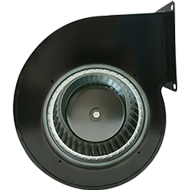
A backward curved centrifugal fan is a type of centrifugal fan that is designed with blades curved in the opposite direction to the fan rotation. The blades are a few and large curved, which eliminating the requirement of a scroll housing because the velocity pressure has been efficiently converted to air pressure along the blade passages. The outlet angle of the backward curved centrifugal fan blades is usually less than 90 degrees. This is because the working principle of the centrifugal fan is to intake gas from the center, accelerate it, and then discharge it at the outlet of the blades. If the outlet angle(β) of the blades is greater than 90 degrees, the gas will be deflected back, leading to energy loss and unnecessary vibration.
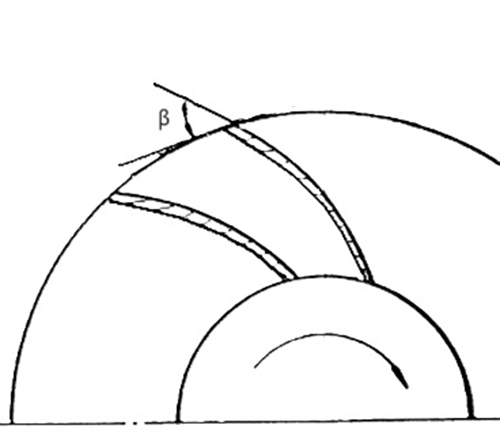
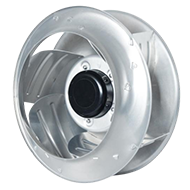
Backward curved impeller:The impeller is the rotating component of the fan that is responsible for creating the airflow. The impeller is made of durable materials typically plastic with glass fiber or aluminum to withstand the forces of rotation and airflow.
Motor and drive assembly:The motor is the power source for the fan, providing the necessary energy to drive the impeller and create airflow. A backward curved centrifugal fan is often equipped with high-efficiency motor to minimize energy consumption and reduce operating cost.
Inlet and outlet connections:The fan has inlet and outlet connections for the intake and discharge of air. These components are designed to minimize pressure losses and air leakage, ensuring the fan operates at maximum efficiency.
Backward curved centrifugal fans are noticeable for high efficiency, low noise, and ability to handle a wide range of airflow and pressure requirements. They are commonly used in HVAC systems, industrial ventilation, and air pollution control applications.
One of the key advantages of backward curved centrifugal fans is their high static efficiency owing to the design of the fan blades. This design allows for smooth and efficient airflow, resulting in reduced energy consumption and lower operating costs. In addition, the backward curved blades also contribute to the low noise levels produced by these fans, making them ideal for applications where noise control is a priority.
Furthermore, backward curved centrifugal fans are capable of handling a wide range of airflow and pressure requirements. This versatility makes them suitable for a variety of applications, from small-scale HVAC systems to large industrial ventilation systems. Their ability to effectively handle varying airflow and pressure demands makes them a reliable choice for engineers and designers in different industries.
 EN
EN
 AR
AR CS
CS NL
NL FR
FR DE
DE EL
EL HI
HI IT
IT KO
KO PL
PL PT
PT RU
RU ES
ES ID
ID LT
LT SK
SK SL
SL UK
UK VI
VI HU
HU TH
TH TR
TR MS
MS ZU
ZU XH
XH BN
BN EO
EO ML
ML TE
TE JA
JA RO
RO MY
MY IW
IW HR
HR SR
SR FI
FI DA
DA SV
SV TG
TG NE
NE LB
LB KM
KM